
Schools of a Changing Society
Tracing the materialisations of values and ideals in Stockholm public schools 1950-2020
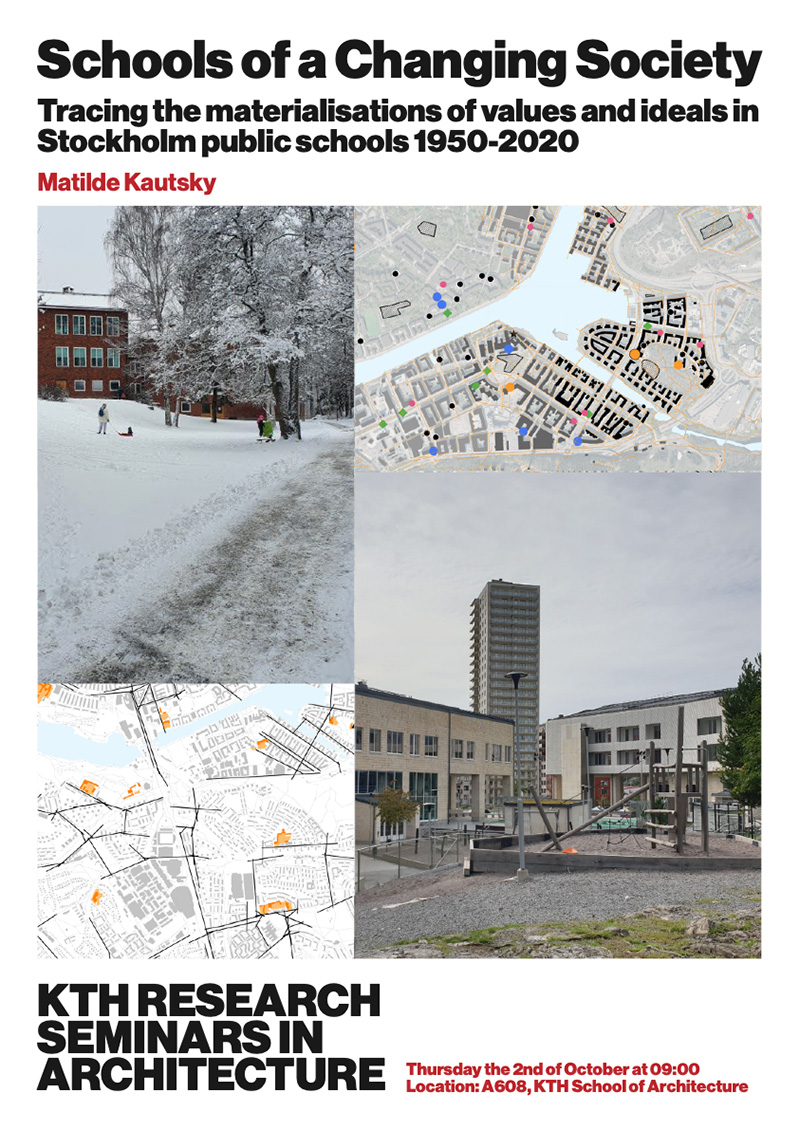
At the Research Seminars in Architecture on Thursday, the 2nd of October, Matilde Kautsky will present her PhD project: Schools of a Changing Society - Tracing the materialisations of values and ideals in Stockholm public schools 1950-2020.
Time: Thu 2025-10-02 09.00 - 12.00
Location: Conference Room 6th Floor of the Architecture School Room A608
Video link: https://kth-se.zoom.us/j/67185547897
Each society produces its school system and its schoolyards, which in turn express the ideas and goals of that society and system—concretely and mundanely, but also symbolically.[1]
How are changes in society materialised in the architecture of everyday places? The thesis explores how material traces of societal change are reflected in architecture, through a study of public schools in Stockholm, built between 1950–2020. Utilising architectural and spatial analyses, examining the presence, visibility, and context of various schools in Stockholm, and their architectural and urban changes over time, the thesis contributes to a discussion about how political decisions and societal ideals shape our urban environment.
The material traces are investigated through a selection of architectural and spatial analyses. The hypothesis is that the presence of schools (as in their location and visibility), what is next to them (what does the context afford) and the exposure of the schoolyards, as well as the design of the school, are all material traces of societal ideals concerning education, play and discipline. Societal changes are understood primarily through text-based sources; state architectural guidelines for schools, state reports, planning documents, and the Swedish Journal of Architecture. The regulations, recommendations and discussions about locations, programs, functions of the school, schoolyard, and neighbourhood are analysed in order to understand what has changed over time, and what has remained the same. The results reveal that while some parts of the proposals and regulations were implemented, others were not, reflecting the degree to which certain societal ideals impacted school planning and design. Learning about the materialisations of societal changes over time opens up a discussion about the past, which has the potential to enhance our understanding of the role of contemporary ideals on how they will be materialised in architecture.[2]
The constant negotiations and prioritisations of how to structure a city are one of the facets of society, and part of the complexities involved in urban design and planning. It is the constant negotiations in the city, the societal processes of organising space, which are interesting to investigate. To understand more about how societal changes are reflected in the city, impacting both the contemporary and future day-to-day life.
The opponent for the seminar will be Sam Griffiths Associate Professor in Spatial Cultures in the Space Syntax Laboratory at the UCL Bartlett School of Architecture
Please contact Matilde Kautsky for a copy of the manuscript - matilde.kautsky@arch.kth.se
BIOs
Matilde Kautsky is a PhD candidate, architect and teacher in Architecture and Urban Design at the School of Architecture, KTH. Her investigation explores how societal values and ideals are reflected in the city. More specifically she studies schools and schoolyards in Stockholm and what material traces they contain from societal ideals and values. As a teacher within the Sustainable Urban Planning and Design master’s program, she is interested in exploring the possibilities of planning and designing another kind of city together with the students.
Sam Griffiths is an Associate Professor in Spatial Cultures in the Space Syntax Laboratory at the UCL Bartlett School of Architecture. His research addresses the historical relationship between people and their built environments, the spatial culture of industrial cities, the role of architecture in historical writing and space syntax as an interdisciplinary research perspective in the humanities and social sciences. He has published a number of articles and book chapters on these topics, including on the potential for using space syntax in urban heritage and conservation. He is co-editor, with Alexander von Lünen, of Spatial Cultures: Towards a New Morphology of Cities (Routledge, 2016), and author of Writing the Materialities of the Urban Past: Cities and the Architectural Topography of Historical Imagination (Routledge, 2021).
[1] Anna Larsson, Björn Norlin, and Maria Rönnlund, Den svenska skolgårdens historia: skolans utemiljö som pedagogiskt och socialt rum (Lund: Nordic Academic Press, 2017), 247. “Varje samhälle producerar sitt skolsystem, och sina skolgårdar, vilka i sin tur uttrycker samhällets och systemets syften och mål, fysiskt och vardagligt och dessutom symbolikst.” (translation by author)
[2] Håkan Forsell, Urbana Infantil: Stadsmiljö, pedagogik och kunskapssamhälle i metropolernas tidevarv 1900-1930 (Lund: Sekel, 2012).