
Research Seminar in Architecture Series
Book Launch
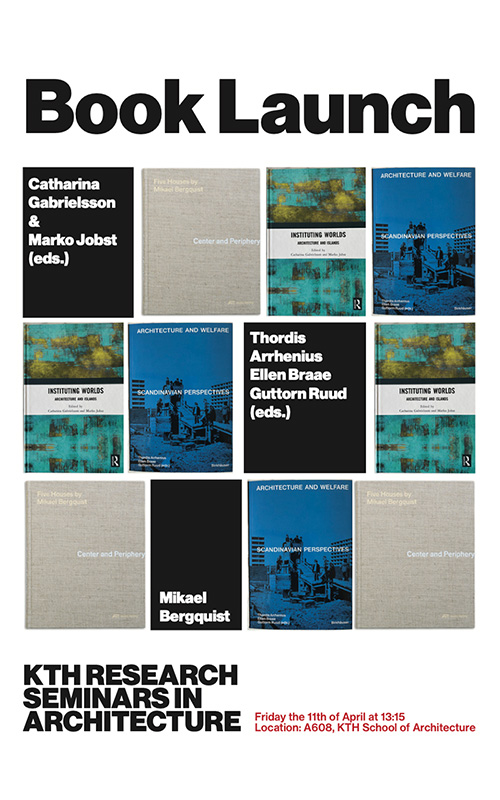
Welcome to the Research Seminars in Architecture for a special book launch seminar featuring three of our colleagues from the KTH School of Architecture: Thordis Arrhenius, Catharina Gabrielsson, and Mikael Bergquist.
Tid: Fr 2025-04-11 kl 13.15 - 16.00
Plats: A608
Videolänk: https://kth-se.zoom.us/j/67185547897
Thordis Arrhenius, Catharina Gabrielsson, and Mikael Bergquist will present three newly published books that explore architecture’s relation to welfare, islands, and peripheral domestic landscapes. Each will introduce their respective volume and reflect on the writing and editorial processes that shaped it, touching on collaboration, methodology, and the politics of architectural publication.
The event will begin with presentations and a discussion on the making of the books, touching on editorial collaborations, critical writing practices, and the politics of architectural publication. A conversation between the authors will follow, with time for questions from the audience.
Architecture and Welfare: Scandinavian Perspectives
Edited by: Thordis Arrhenius, Ellen Braae, and Guttorm Ruud
Publisher: Birkhäuser
Architecture was fundamental to the realisation of welfare state policy in the Nordic countries, translating democratic ideals into concrete spatial materialisations. An inclusive notion of “welfare for all” was embraced by a generation of architects, landscape architects, and planners, who laboured to give physical form to ideas of equality, collectivity, and democracy, producing a vast architectural output in Scandinavia during the postwar years. Today, however, the architectural legacy of this era is contested. Welfare for all no longer enjoys the social or political consensus it once did.
This publication critically engages with this contested architectural legacy and provides a nuanced portrait of postwar welfare architecture coming to terms with a contentious past and facing an uncertain future.
With newly commissioned photographic work by contemporary Nordic artists.
Based on an interdisciplinary research project by KTH Stockholm, Oslo School of Architecture, University of Copenhagen.
Internationally renowned contributors shed light on aspects of the relationship between architecture and welfare.
Thordis Arrhenius is Professor of Architecture at the School of Architecture, Royal Institute of Technology (KTH) Stockholm. She is a Marchitect and researcher with a strong engagement in contemporary architectural and urban practice and their theories. Recent research projects investigate the role of the architectural exhibition in the reception of modern architecture in Scandinavia, the historiography of conservation, the strategy of re-use, and its architectural and theoretical implications. Publications include The Fragile Monument: on Conservation and Modernity (Artifice books on Architecture, 2012); the co-edited anthologies Place and Displacement and Exhibiting Architecture (Lars Müller Publishers, 2014); and Experimental Preservation (Lars Müller Publishers, 2016).
Instituting Worlds: Architecture and Islands
Edited by: Catharina Gabrielsson and Marko Jobst
Publisher: Routledge (2025)
Islands have a long history of appealing to the architectural imagination and have served as sites for architectural expressions of cultural specificity, cultural conquest, and cultural hybridisation over millennia. From offshore financial centres to immigrant detention camps, tourist havens to military bases, the architectures of islands concretise the forces at play in our contemporary, crisis-ridden societies.
Collecting writings by a wide range of established scholars together with exciting new voices in architecture and affiliated disciplines, this book shows the pertinence islands hold for critical spatial thinking and practice today. Covering war and colonialism, detention and tourism, the topics raised in this book range from issues of urban development to close readings of buildings – whether ruined, designed, projected, preserved, or absent. Combining case studies, critical historiography and pieces of experimental writing, the chapters disclose the variety of ways in which architecture can be used as a lens for analysing, disclosing and untangling island specificity.
This volume offers a very timely, vibrant, and methodologically varied approach to the subject of architecture and islands. Its global reach, innovative outlook and rich material will be of interest to scholars and students in architecture, landscape architecture, geography, urban design and planning, alongside arts and literary studies.
Catharina Gabrielsson is Docent in Architecture and Professor in Urban Theory and Design at the School of Architecture KTH, Stockholm. Her research centres on the relationship between architecture, art and urban development, combining critical historiography with philosophy and artistic research. She is co-editor of Neoliberalism on the Ground: Architecture and Transformation from the 1960s to the Present (2020), Architecture and Feminisms: Ecologies, Economies, Technologies (2017) and Deleuze and the City (2016).
Marko Jobst is Senior Lecturer at Leeds School of Architecture. He is the author of A Ficto-Historical Theory of the London Underground (AADR, 2017) and co-editor of Architectural Affects After Deleuze and Guattari with Prof Hélène Frichot (2021), and Queering Architecture: Methods, Practices, Spaces, Pedagogies with Prof Naomi Stead (2023). His research interests include the philosophy of Gilles Deleuze, affect and queer theories, and experimental modes of writing.
Centre and Periphery: Five Houses by Mikael Bergquist
Author: Mikael Bergquist
Publisher: Park Books (2024)
This book brings together five vacation homes in Sweden designed by Stockholm-based architect Mikael Bergquist. Realised over more than two decades, they are all located in the Swedish countryside and rooted in the Nordic tradition of timber construction and the simplicity and economy of Sweden’s historic farm buildings. Bergquist’s great attention to detail and careful choice of materials characterise these houses. They are united also by a close relationship to the surrounding landscape and nature, which is enhanced as an experience by the concepts of movement and the placement of passages between the outside and inside.
The houses are documented with photographs as well as plans and sections. In his supplementary essay, Bergquist writes about the special position of working as an architect on the periphery of Europe. He draws a picture of Swedish architecture that is marked by what he calls “fruitful misunderstandings” of current movements, and one in which the poverty of the rural population has been a major factor in the evolution of the design and construction of dwellings.
Mikael Bergquist is an architect educated at KTH and the Academy of Fine Arts, Copenhagen. He runs his own office in Stockholm and teaches a Master studio at KTH. His work includes a long line of small wooden houses as well as renovations of historically significant buildings, shops, and restaurants. He has written and curated numerous exhibitions and books.