
Circular Hybrid Facades
A Parametric Design-to-Fabrication Method for Integrating 3D Concrete Printing and Reuse
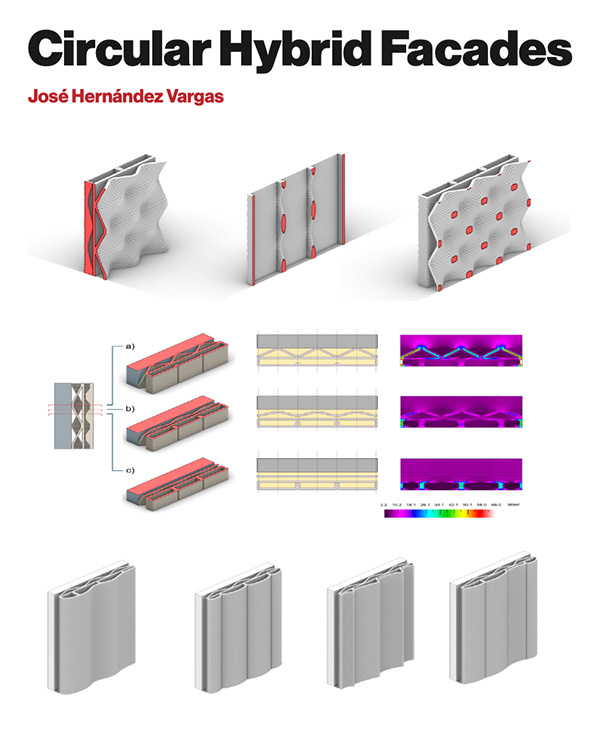
At the Research Seminars in Architecture, Friday, the 12th December, PhD candidate José Hernández Vargas will be presenting his research titled Circular Hybrid Facades: A Parametric Design-to-Fabrication Method for Integrating 3D Concrete Printing and Reuse.
The Opponent for the session will be PhD Candidate Emilio Brandao.
Time: Fri 2025-12-12 13.15 - 16.00
Location: Conference Room 6th Floor of the Architecture School Room A608
Video link: https://kth-se.zoom.us/j/67185547897
This paper introduces a hybrid approach that combines 3D concrete printing (3DCP) with the reuse of structural precast concrete elements to improve environmental performance in facade design. The study explores a design-to-fabrication workflow that allows for the production of customised 3D printed skins, capable of adapting to geometrically irregular reused components. These outer layers are parametrically optimised for porosity, shading, and insulation, while also enabling disassembly and reuse. The methodology integrates parametric modelling, environmental simulation, and manufacturing constraints to develop modular, adaptable façade elements. Simulation results and fabrication trials highlight trade-offs among thermal performance, material efficiency, and printability. Compared to traditional methods, the system reduces material consumption and enhances circularity. The findings suggest that integrating 3DCP with reuse strategies offers a viable framework for sustainable, high-performance envelope design in architecture.
Bios
Emilio Brandao is an architect and PhD-student at KTH School of Architecture, within the project CoNECT: Collective Networks of Everyday Community Resilience and Ecological Transition. And for the last 12 years he has been a lecturer in design activism at Chalmers University of Technology. Both his research and awarded teaching experience (UIA Innovation in Architectural Education Award 2022-2023) are interested in urban practices and pedagogies for social inclusion and community resilience. Emilio works with collaborative methodologies of co-creation, and design and build, together with multiple local actors. His work engages with contexts highly challenged by diverse socioeconomic inequalities and urban injustices, both locally in Sweden and internationally, and built on experience from architectural practice, action-based teaching and research, and active engagement in NGOs.
José Hernández Vargas is an architect trained at the Pontificia Universidad Católica de Chile (Catholic University of Chile) and a PhD candidate in Civil and Architectural Engineering at KTH, within the Division of Concrete Structures. His research investigates how 3D concrete printing enables the local manipulation of geometry, porosity, and material distribution to produce components with enhanced mechanical performance. His licentiate thesis explored spatially graded modelling and the structural implications of customised internal geometries for reducing concrete consumption while maintaining