
Transforming Giron-Kiruna
At the Edges of Space, Nature, and Society in Swedish Sápmi
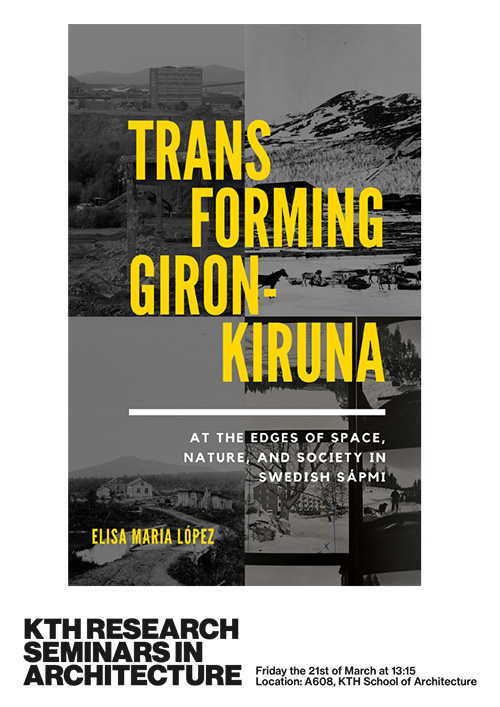
This Friday at the Research Seminars in Architecture, Postdoctoral researcher Elisa Maria López will present an overview and chapter from her forthcoming monograph Transforming Giron-Kiruna: At the Edges of Space, Nature, and Society in Swedish Sápmi.
The opponent for the Session will be PhD candidate Seren Dincel.
Time: Fri 2025-03-21 13.15 - 16.00
Location: A608
Video link: https://kth-se.zoom.us/j/67185547897
In this seminar, Elisa Maria López will present an overview and a sample chapter from a monograph she is writing for an academic press based on a complete revision of my dissertation, provisionally titled Transforming Giron-Kiruna: At the Edges of Space, Nature, and Society in Swedish Sápmi. Based on ongoing anthropological research López has conducted in Giron-Kiruna since 2012, it is an ethnography and environmental history of “edge spaces” in Giron-Kiruna : dynamic sites of tension at the interface of two or more socio-ecological worlds. Edge spaces, López argues, are socially and spatially co-produced (Lefebvre 1991) by “edge configurations”: more-than-human assemblages of actors and environments in spaces of tension, double-binds, and fragmentation, but also flexibility, movement, and possibility, exemplified in diverse forms from national and internal political borders to the area’s unique sub-arctic boreal forest and tundra ecology. Building on philosopher Edward S. Casey’s (2017:3) proposition that the world is a “plurality of edges” which humans and non-humans encounter and transcend in their everyday lives, Transforming-Giron Kiruna demonstrates that apprehending and thinking with edge spaces offers a fine-grained understanding of ‘topograph[ies] of power’ (Gupta and Ferguson 1992) in contexts of intensive planetary extraction, colonialism, and legacies of inequality, and how humans and non-humans shape, inhabit, and navigate life upon edge worlds in their making and unmaking.
Contact elopez@kth.se if interested in reading the sample chapter.
Bio Elisa Maria López is a postdoctoral researcher in Architecture, Culture, and Environment at KTH Royal Institute of Technology, School of Architecture who earned her PhD in anthropology from Uppsala University in 2021. She came to KTH in Fall 2022 as postdoctoral research on the VR-funded project, “Utopia 2.0: ‘Nature-Thinking’ in Nordic New Towns of the Past, Present, and Future” together with Associate Professor Jennifer Mack (PI) and PhD candidate Alejandra Navarrete Llopis. Since Fall 2024, her postdoctoral work has also been supported by the Lars Erik Lundberg Foundation. An environmental anthropologist with a historical orientation, her research spans themes of urban and environmental history, resource-society relations, and colonial forms of knowledge production to architectural, urban planning, and design practices with a regional focus on the Nordic Arctic/Sápmi.
Opponent Seren Dincel is a practising lighting designer trained in interior design and architectural lighting. She is currently a doctoral student in Architectural Design, Technology and Representation at KTH School of Architecture. She holds master’s degrees in Architectural Lighting Design from Hochschule Wismar and Interior Architecture and Environmental Design from the Sapienza University of Rome and a bachelor’s degree from Bahcesehir University of Istanbul. Her work in practice concerns urban lighting design projects in Sweden and the Middle East. In the doctoral project, she investigates ways of integrating spatial, ecological and technological systems into after-dark planning with a focus on accommodating multispecies in urban green areas. The doctoral project is part of the transdisciplinary research consortium NorDark funded by NordForsk and the Swedish Energy Agency.