
Transmediation: A Spatial Methodology for Engaging Permanent Pollution
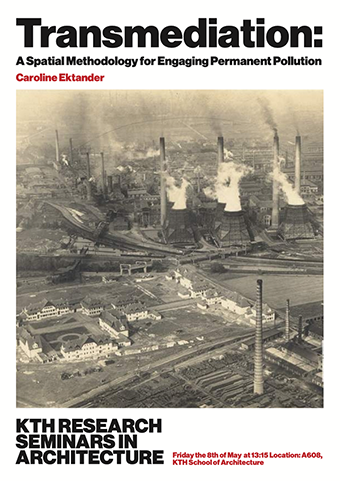
The seminar offers an overview of the practice-based PhD project Toxic Commons – Transmediating Permanent Pollution, with a focus on its methodological contribution. Taking the polluted industrial landscapes of former East Germany as its point of departure, the research examines how state-led clean-up processes have reshaped environmental harm, reducing visible pollution while obscuring more diffuse and persistent toxicities.
Time: Fri 2026-05-08 13.15
Location: Conference Room 6th Floor of the Architecture School Room A608
Participating: Caroline Ektander
This talk presents a condensed overview of the practice-based PhD project Toxic Commons: Transmediating Permanent Pollution, with a focus on its methodological contribution.
Taking the heavily polluted industrial landscapes of former East Germany after the fall of the Iron Curtain as its point of departure, the research explores how subsequent state-sanctioned clean-up campaigns reorganised environmental harm spatially by containing it within bounded sites and stabilising it through mitigation infrastructures. While these efforts quickly mitigated perceptible forms of pollution, such as yellow-grey smoggy skies, open coal mines, and acrid chemical smells, they simultaneously obscured more diffuse and imperceptible toxicities that continue to accumulate and circulate through interconnected commons, including air, water, and soils.
In response, the PhD project develops transmediation, a wordplay on remediation, the technical term for industrial clean-up, as a relational methodology grounded in critical spatial practice. Rather than approaching pollution as an object to be contained, transmediation understands it as both materially and conceptually leaky and therefore requiring more fluid forms of engagement. Through site-specific artistic fieldwork and curatorial strategies centred on the so-called inferior senses of smell, touch, sound, and taste, transmediation troubles the illusion of clean-up and insists that pollution does not disappear simply because it is no longer seen.
Through transmediation, it becomes clear that clean-up operates as an ambivalent spatial technology. It mitigates perceptible forms of pollution while simultaneously producing vanishing acts through which pollution continues to accumulate and circulate within an expanding toxic commons. This relational complexity, characterised by shifting scalar effects across time and space, points beyond the East German case to broader spatial dynamics of extractive modernity and its ongoing transformation across landscapes increasingly internalised into Europe.
Caroline Ektander is an architect with an M.Arch from KTH, a research curator, and a transdisciplinary environmental humanities scholar working at the intersection of artistic research and critical spatial theory. Her work engages with the politics of pollution and the longue durée effects of extraction, exploring how environmental harm can be made present and meaningful through spatial and sensory practices for different publics. She recently completed her practice-based PhD at Bauhaus-Universität Weimar in 2026, developing the concept of transmediation as a relational methodology for engaging permanent pollution. Caroline is a co-founder of the art–science platform Toxic Commons, founded in 2018, and serves as an advisor to the Toxic Heritage research cluster, established in 2025. She has written, lectured, and taught widely on toxicity, pollution, and environmental justice.