
Real Estates
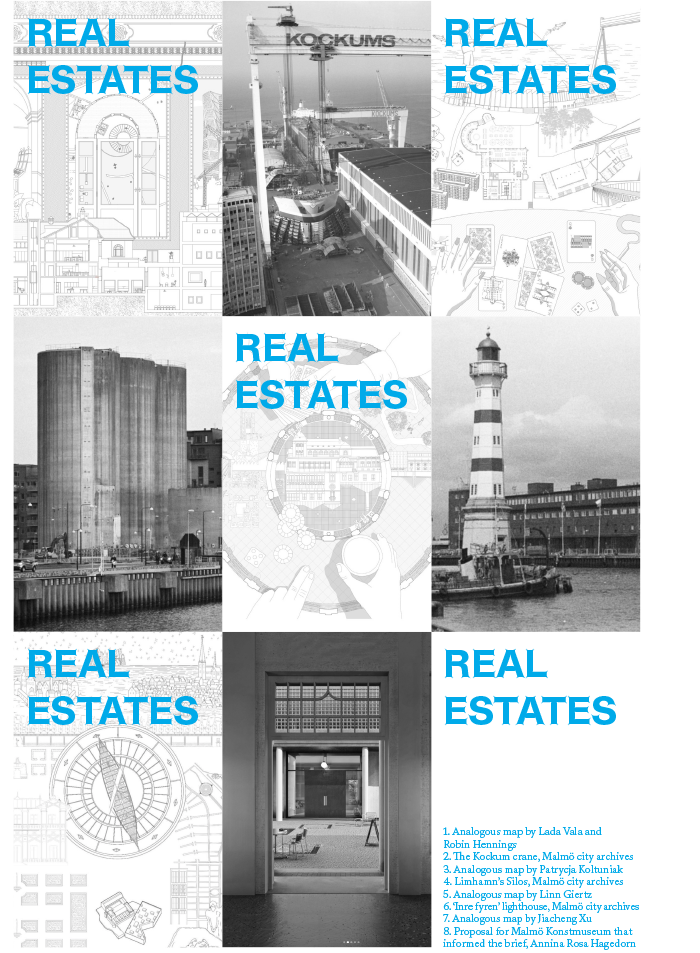
Studio Theme – The Central Archive
Once important cultural and political symbols, centrally located and accessible to the public, archives and storage facilities have become increasingly private affairs. Subject to strict security protocols, insurance demands and an unforgiving economic logic, they take the form of nondescript boxes with closed façades on the peripheries of our cities, storing our valuable items, knowledge and data away from public view. Yet, if archives and the information they store and classify still have political power, perhaps it is time to return to this overlooked building type to activate its cultural, social and spatial potential? The area of Nyhamnen in Malmö is a perfect testing ground: a landscape of former shipbuilding warehouses and industrial shells storing everything from grain and logistics infrastructure to valuable artworks, suspended between its industrial past and its projected future as an extension of Malmö’s city centre and its next waterfront district. This transformation is not without conflict, as private and public interests negotiate the terms of its future, the area remain a social and cultural void in what was once a focal point of the harbour and the city as a whole. In the northern part of the site, behind a red brick façade, 39 000 publicly owned artworks from the city’s arts collection remain locked away in a warehouse that faces an uncertain future.
In the autumn of 2026, the City of Malmö will announce the international competition for the transformation of a former Casino into a new Museum for the collection, two kilometres southwest of the site. Plans for future storage and maintenance of the works are not yet set.
This fall, students at REAL ESTATES, together with Malmö Stad, explores how public storage infrastructure can be reprogrammed, using obsolescence as a point of departure to imagine new spaces, institutions and rituals for collective life.
Studio Method
REAL ESTATES approaches architecture as a civic and critical practice. We work with publicly owned sites facing uncertain futures. We ask, prior to development or demolition, what other values, uses and users might already exist. We are interested in the capacity of architecture to engage with the real, not as a given but as something continuously produced that can be challenged, negotiated and transformed through design. We develop projects that critically engage with contemporary spatial, social and cultural conditions through research, drawings, text, models, images, planning applications, legal code and economic spreadsheets. We operate as a collaborative environment in which individual proposals contribute to a shared enquiry. We work with rigour, precision and clarity, seeing architecture as a proactive instrument that not only responds to a brief, but has the power to shape policy.
We engage external guests including Finn Williams (City Architect), Jonas Janke (B+), Peter Ström (Graphic Designer) and Asrin Heidari (Moderna Museet) to situate our work across disciplines and in relation to the public interest.
Competencies
• To produce project work of increasing sophistication, that explores relationships between historical, theoretical and practical design issues. Understand link between design work and professional practice by engaging with real clients.
• To develop methodologies for archival and site research, surveying and working with existing buildings, understanding of the relationship between architecture and the social, cultural, economic and environmental conditions that shape it.
• To apply and integrate aesthetic and technical skills with critical awareness and develop visual, verbal and written communication skills using drawings, models, texts and images.
M2 Magasinet
We will start the term by going to Malmö in order to study the area of Nyhamnen and its M2 central storage warehouse, building on previous work by students at the Royal Institute of Art, in order to understand the local context, the logistics of art storage and the needs of the city. We then propose an intervention and a strategy for the future use of the building.
Malmö Storehouse
Working in parallel with and feeding into the international competition for Malmö Konstmuseum, we will produce designs and speculations for how the collection can and should be stored in the future and what the role of the archive should play in the new museum.
The projects will be presented to representatives of Malmö Stad and Malmö Konstmuseum and exhibited at the Museum.
Teachers: Carolina Wikström, Love Di Marco