
Enactment of the Authentic Original: Conservation-restoration of kalkmålningar in Swedish churches
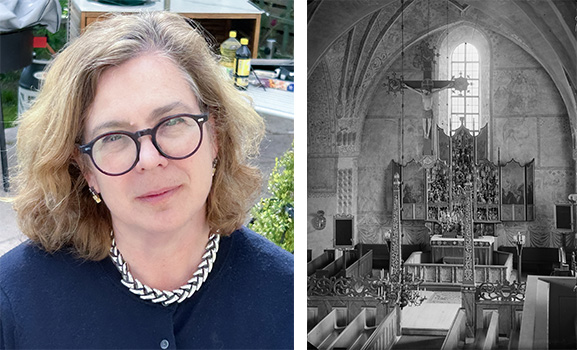
Hélène Svahn Garreau at the Department of Architecture will publicly defend her doctoral thesis on 13 February 2026.
What is the topic of your Doctoral Thesis?
The dissertation addresses the conservation-restoration of kalkmålningar in Swedish church interiors between 1850 and 1980 in a European context. The aim is to understand how the paintings have been treated through different enactments within a network with actors.
Why did you choose this topic?
Conservation-restoration as a theoretical subject has interested me ever since I trained as a conservator-restorer in Florence in the early 1990s. When I returned to Sweden, I encountered approaches and principles different from those I had learned in Italy. This sparked my curiosity. How could conservation-restoration differ from one country to another? Some approaches were similar, others were not. What were the foundations of these differences? Over time, my interest grew in how kalkmålningar have been treated historically as a cultural heritage. I wanted to analyse the changes, and this led to a deep dive into different theoretical perspectives.
What are the most important results?
That the dissertation facilitates an understanding of what conservation-restoration is. The analysis of the history of conservation-restoration in Sweden enables a better understanding of what we do today and tomorrow within the field of conservation-restoration.
Did you come across something unexpected during your thesis research?
I was surprised that the theoretical foundations of conservation-restoration had not been highlighted to any significant extent. Over time, I have been pleased to see that interest has grown. This was not self-evident when I began the work. I was also surprised that the conservation-restoration methods developed in Sweden in the early 20th century were so unique and ahead of their time. The future Riksantikvarie at the Swedish National Heritage Board, Sigurd Curman, played an important role here.
Who will benefit from your results? What kind of impact may it have on surrounding society?
Professionals working in cultural heritage management can gain greater insight into what conservation-restoration is and how conservation-restoration practices in Sweden have changed over time. Furthermore, the work may contribute to a deeper understanding of conservation-restoration as a potentially sustainable approach and how it is challenged today. In the epilogue, I highlight some contemporary tendencies that may spark discussion about where we are heading.
What will you do next and where can one reach you?
I work as a heritage consultant, including with conservation-restoration matters, at Tyréns Sverige AB in Stockholm, and I hope to continue conducting research within the field.